
Low Energy, Brain Fog, and Mood Swings After 40? Men Get Hormone Imbalance Too

Low Energy, Brain Fog, and Mood Swings After 40? Men Get Hormone Imbalance Too
You used to bounce out of bed in the morning. Now the alarm goes off and you’re already calculating how soon you can justify going back to sleep. The gym sessions that used to energize you feel like a slog—and recovery takes days instead of hours. You’re forgetting things, losing your train of thought mid-sentence, and struggling to focus in meetings that used to feel effortless. And there’s a short fuse you can’t quite explain—more irritable, less patient, less motivated than you remember being.
Most men in their 40s and 50s chalk this up to work stress, poor sleep, or just getting older. Sometimes those things are contributing. But there’s often something else going on underneath all of it: testosterone is declining. And when it does, it takes energy, mental sharpness, emotional stability, and drive with it.
Hormone imbalance in men doesn’t get the cultural attention that menopause gets for women. But it is just as real, just as measurable, and just as treatable.
low testosterone men andropause
What Is Andropause—and Is It Real?
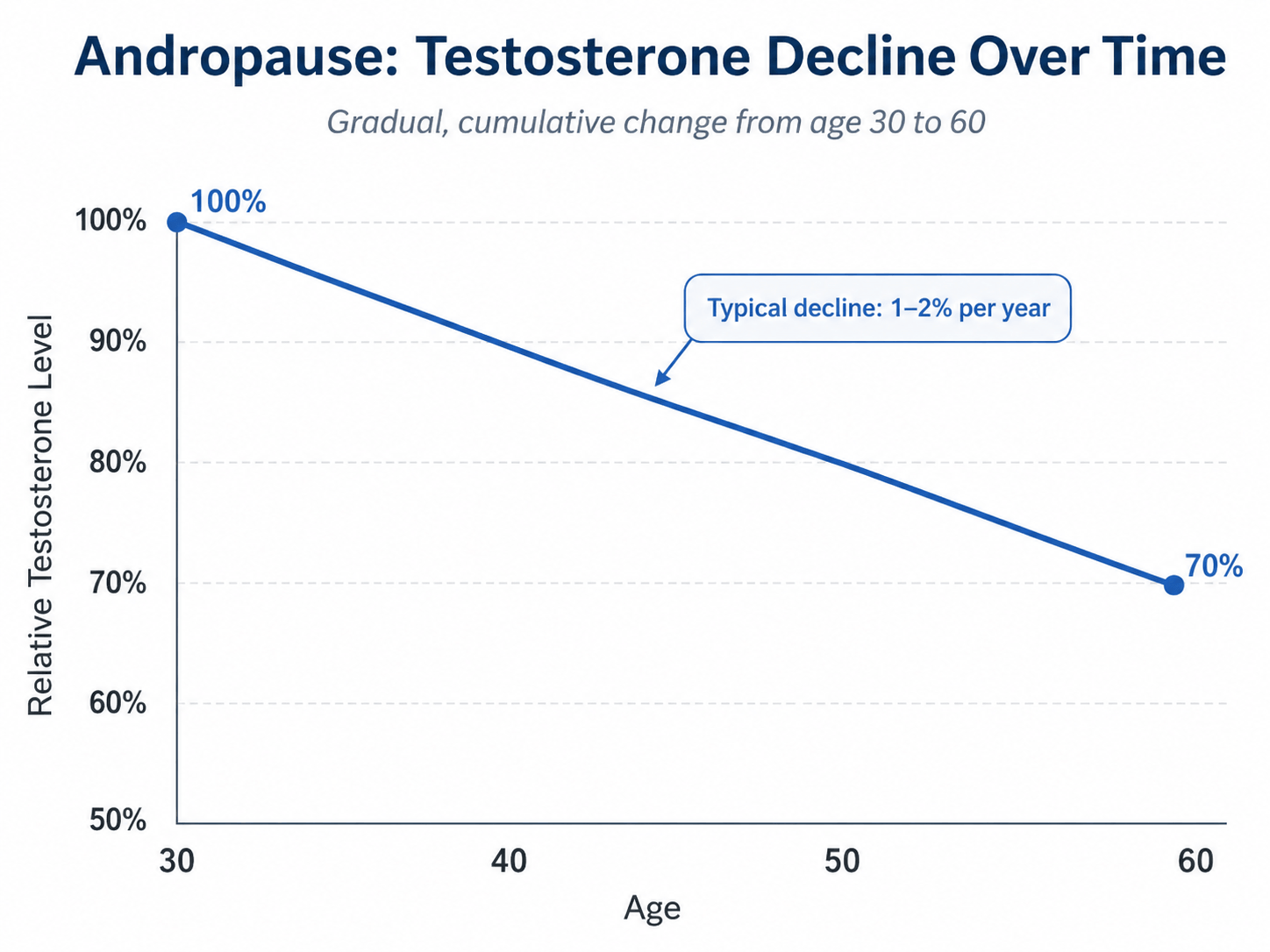
Andropause—sometimes called male menopause or simply low-T—refers to the gradual, progressive decline in testosterone that begins for most men in their early 30s and continues at roughly 1–2% per year. Unlike menopause, which involves a relatively rapid hormonal shift over a span of years, andropause is slow and cumulative. It rarely announces itself dramatically. Instead, it accumulates quietly over a decade or more until the gap between how you feel now and how you remember feeling becomes impossible to ignore.
By the time men are in their mid-to-late 40s, many have testosterone levels that are meaningfully lower than they were in their prime—even if those levels still fall within what a standard lab report calls “normal.” That reference range is the key issue. It was built to encompass the full adult male population: men in their 20s, men in their 70s, men in excellent health and men with chronic illness. A 47-year-old at the lower end of that range is technically normal. But optimal for a 47-year-old is not the same as average across all ages—and treating a number without treating the patient misses the point entirely.
Schedule your treatment session today.
Call today for more information or to book an appointment, 513-891-2478
low testosterone men andropause
The Three Symptoms Men Most Often Describe
Fatigue and loss of drive
Testosterone supports energy production at the cellular level. It influences mitochondrial function, stimulates red blood cell production, and affects how efficiently the body uses oxygen and metabolic fuel. When testosterone drops, energy levels follow—not the kind of tired that a good night’s sleep reliably fixes, but a chronic, underlying flatness that shows up every single day.
Men often describe this not just as physical tiredness but as a loss of the internal drive that used to come naturally. Work that felt engaging now feels like effort. Physical activity that once felt rewarding now requires convincing yourself to start. The things that used to be satisfying—a productive day, time with family, a hard workout—require more and deliver less. This is one of the most underreported symptoms of low testosterone precisely because it’s so easy to attribute to external circumstances rather than internal biochemistry.
Brain fog and mental slowing
Testosterone receptors are distributed throughout the brain, and the hormone plays a meaningful role in cognitive functions including working memory, processing speed, verbal recall, spatial reasoning, and the ability to concentrate under pressure. Research consistently shows that lower testosterone is associated with reduced performance on cognitive tasks—and that restoring testosterone to optimal levels improves these measures.
Men experiencing low testosterone frequently describe a cognitive shift that predates any diagnosis: words that used to come quickly now take a moment to surface. Decisions that once felt clear now feel labored. Mental sharpness that felt like a reliable tool in their 30s has become less dependable. This is not a character flaw or a sign of aging. It is a neurological effect of declining hormone levels—and it responds to treatment.
Mood changes, irritability, and low motivation
Testosterone influences the brain’s dopamine and serotonin systems—the neurotransmitters most directly tied to motivation, reward, pleasure, and emotional regulation. When testosterone is low, these systems function less effectively. The result is often described not as clinical depression but as a persistent gray flatness: things that used to feel worthwhile no longer carry the same weight. Patience is shorter. Enthusiasm is harder to access. Small frustrations land harder than they should.
This is one of the most overlooked dimensions of low testosterone in men because it is so easy to attribute to stress, relationship dynamics, work pressure, or simply personality. But for many men, the mood shift is biochemical—driven by the same hormonal decline affecting their energy and cognitive function—and it responds to the same treatment.
“If you are hesitant to explore hormone replacement, don’t be. Going here was one of the best decisions I have ever made.”
Stephen
Cincinnati

Schedule your treatment session today.
Call today for more information or to book an appointment, 513-891-2478
low testosterone men andropause
Why “Your Labs Are Fine” May Not Be the Whole Story
Standard testosterone panels measure total testosterone and compare it against a broad population reference range. A man in his late 40s whose result falls at the low end of that range will typically be told his levels are normal—because they are, relative to the population. But that population includes men of every age and health status, and the range is wide by design.
A more complete evaluation looks at free testosterone—the biologically active fraction that is actually available to tissues—rather than just the total. It considers sex hormone-binding globulin (SHBG), which binds to testosterone and reduces its availability. And it evaluates symptoms in context, not just a number against a range. Two men can have the same total testosterone level and have very different experiences—because bioavailability, receptor sensitivity, and individual baseline all matter.
At Vigour, we don’t treat lab values in isolation. We treat patients.

low testosterone men andropause
How BHRT Works for Men at Vigour
Men at Vigour are evaluated with the same thoroughness applied to every patient. We review bloodwork in clinical context, take a detailed symptom history, and build a treatment plan based on your individual biology—not a one-size-fits-all protocol.
For men whose symptoms have a hormonal basis, BHRT via the SottoPelle® pellet method delivers consistent testosterone levels over a period of months—without the peaks and drops that come with weekly injections or daily gels. Consistent hormone delivery means consistent symptom relief, without the mood and energy fluctuations that can accompany other delivery methods.
Men who address low testosterone through personalized BHRT at Vigour often report:
- Significantly improved physical energy and endurance
- Sharper mental focus and faster cognitive processing
- More stable mood and greater emotional resilience
- A return of the internal motivation that had been absent
- Better sleep quality and faster physical recovery
- Improvements in body composition as lean muscle becomes easier to maintain
Ready to explore a personalized plan? Book a BHRT consult with our clinic.

About Vigour and Dr. Bobbitt
Vigour is a Cincinnati-based hormone health practice specializing in bio-identical hormone replacement therapy using the SottoPelle® method. Dr. Bobbitt works with both men and women experiencing the effects of hormonal decline—building personalized treatment plans that address the cause of symptoms rather than managing them in isolation.
Men are a meaningful part of the Vigour patient population. Low testosterone is not a niche concern or a secondary service—it is a core part of what we treat, and we approach it with the same clinical rigor and individualized care we apply to every patient.
Vigour is located at 7629 Kenwood Road in Cincinnati’s Kenwood neighborhood, serving patients throughout the greater Cincinnati area.
low testosterone men andropause
FREQUENTLY ASKED QUESTIONS
How do I know if my symptoms are from low testosterone or just stress and aging?
The honest answer is that you often can’t tell without an evaluation. Stress, poor sleep, and aging can all produce symptoms that overlap significantly with low testosterone—fatigue, mood changes, difficulty concentrating. The key distinction is whether those symptoms are persistent, progressive, and accompanied by a measurable hormonal deficit. An evaluation at Vigour looks at the full picture: bloodwork in context, symptom history, and your individual baseline. That’s a more reliable answer than guessing.
My doctor said my testosterone is normal. Why do I still feel terrible?
Because “normal” is a range, not a target. A result at the low end of the reference range is technically within normal limits—but it may not be optimal for you specifically, at your age and health status. Free testosterone, SHBG, and clinical context all matter. If your symptoms are real and persistent, they deserve a more complete evaluation than a single total testosterone number against a population average.
Is BHRT for men safe?
Testosterone replacement therapy has been used for decades and has a well-established safety profile when prescribed and monitored by an experienced provider. The SottoPelle® pellet method produces stable, physiologic hormone levels rather than supraphysiologic spikes, which is associated with a better safety and tolerability profile than some other delivery methods. Candidacy is always evaluated individually based on your full health history.
How long before I notice results?
Most men begin noticing improvements in energy and mood within the first three to four weeks following pellet insertion. Cognitive improvements and physical changes in body composition typically develop more gradually over two to four months. Results tend to build and stabilize over successive treatment cycles as hormone levels are optimized.
Will I need to stay on BHRT indefinitely?
Testosterone decline in men is a permanent physiological process—it does not reverse on its own. Most patients who respond well to BHRT and want to maintain the benefits continue treatment on an ongoing basis, returning every four to six months for re-evaluation and pellet re-insertion. The decision to continue, adjust, or stop treatment is always made collaboratively with your provider.
It’s Not Just Getting Older
There is an important distinction between the normal process of aging and the treatable condition of hormone deficiency. Some slowing is natural. But the fatigue, brain fog, and mood shifts that accompany low testosterone are not inevitable—they are symptoms of something that can often be identified and corrected.
If you’re in the Cincinnati area and the description in this post sounds more familiar than you’d like, the conversation is worth having. At Vigour, we see men who have been feeling off for years and assumed it was just life catching up with them. Often, it isn’t.
Contact Vigour at (513) 891-BHRT (2478) or visit youagain.net.